Credit is for people who do not need it
There is an old saying in finance that sounds a little unfair when you first hear it: credit is for people who do not actually need credit. The more you sit with it, the more true it becomes.
A credit card is genuinely useful when you already have the money. Say you are planning to buy something, the funds are sitting comfortably in your account, and your card provider is running an offer that saves you 1,000 to 1,500 rupees on that purchase. You swipe, the money stays in your bank for another few weeks earning whatever little interest it earns, and when the due date arrives you pay it off in full. You saved money, kept your liquidity, and the card worked exactly as it should.
But the moment you reach for a credit card because you want something you cannot otherwise afford right now, you are no longer using a financial tool. You are borrowing against your future income to fund your present lifestyle. That is a very different thing. And that difference is where most people quietly get into trouble.
How it started for me
It was 2018. I was working a regular salaried job when someone explained credit cards to me in the simplest way possible: the bank gives you a certain amount upfront, you use it whenever you need, and pay it back later.
That was enough. Before I had even read the fine print, before I had even applied, one thought had already formed in my head: this means I always have money available. Not borrowed money. Just available money. That single framing, right at the start, set me up wrong.
So I went deep into research. Best credit cards in India. Which bank offers the highest limit. Which one has the best reward points or cashback. I treated it like homework.
Then I found out getting a credit card was not as simple as wanting one. Back then, banks were strict. You needed six months of payslips, bank statements, Form 16 if applicable, PAN, Aadhaar. A proper paper trail before they would trust you with a credit line.
My situation made it harder. My salary came through a cheque, not a direct bank transfer. That one thing caused my applications to either get rejected or simply stop moving forward. I tried multiple banks over several months.
Finally, Yes Bank approved me. They sent someone home for a physical verification visit, the documents passed, and my application moved through their internal process. I watched the status update every day.
A message came saying my card had been dispatched through BlueDart, arriving in 4 to 5 working days. I checked the courier tracking more times than I would like to admit. When it arrived, it came in a blue envelope with my name printed on the front. Inside was a welcome letter. I had been expecting a limit of 50,000 to 75,000 rupees. I got 31,000. I was a little disappointed, but told myself it was still roughly twice my monthly salary at the time. Good enough to get started.
I set up the PIN, downloaded the app, registered the card. Everything was ready. Now I just needed something to buy.
The urge that built up in three days
This part is a little embarrassing to admit. But I think it is the most important part.
I had the card set up and I had no real reason to use it. No upcoming expense, no planned purchase, nothing I actually needed. But the urge to swipe it was real. I could feel it building quietly over the first two days. By the third day, a Sunday, I made a decision.
I ordered lunch from Swiggy. And I paid the bill back to my card account the same day.
My intention was clear: use it once just to feel what it was like, then continue paying immediately like nothing changed. I had read enough by then to understand how credit cards turn on people. I felt informed. Aware. Like I had already figured out the trap before falling into it.
Knowing a trap exists and being immune to it are two completely different things. I was about to find out the difference.
The collectors trap
For the first month or two, the system worked. I used the card for almost every transaction where it was accepted and paid it back the same day or the next. No outstanding balance, no interest, clean cycle. I felt like I had the whole thing figured out.
Then came the phone call.
A telecaller from another bank. She told me I was pre-approved for a credit card with a limit somewhere between 1 lakh and 5 lakhs. I paused at that number. I had gone through months of struggle just to get 31,000. Now someone was offering up to 5 lakhs with a single phone call?
My brain immediately found a justification. A higher credit limit means lower credit utilization, which improves your credit score. That logic is technically correct. But it was not the real reason I said yes. The real reason was that the number felt exciting and I was already looking for an excuse.
She said: limit of 1 lakh to 5 lakhs. The card arrived with a limit of 38,000 rupees. That was the moment I understood that telecallers will tell you whatever gets you to say yes. The actual limit is decided by the bank after evaluating your profile, completely independent of whatever number was quoted on the call.
But here is what I missed at the time. Taking that second card was not a financial decision. It was a psychological one. Once you are already comfortable with one card and paying it back regularly, your resistance to a second one drops to almost nothing. The risk feels manageable because the first one has been fine. You tell yourself you will handle the second one the same way.
Within one year of getting my second card, I had five.
After the second card, I did not even have to submit payslips or bank statements anymore. Banks started reaching out with pre-approved offers or card-to-card basis approvals. They already had enough data on me from my existing credit history. And by then, I was actively looking for reasons to take each new card rather than reasons to decline. One had better cashback on groceries. Another waived fuel surcharges. A third had a decent welcome bonus. Each card had its own story and I believed each one.
The highest limit I managed across all five cards was 50,000 from HDFC. I kept seeing people online talking about limits of 1 lakh, 2 lakhs, even 5 lakhs. But those were premium cards tied to significantly higher income levels. I was not there. Still, chasing that feeling of having more access was already reshaping how I thought about spending.
The debt trap does not begin with overspending. It begins with accumulation. Multiple cards feel like multiple safety nets. What they actually are is multiple open doors. The temptation to spend compounds with every new card you hold, and the justifications get easier each time.
The first real purchase
For a while, life with five cards was actually fine. Electricity bills, mobile recharges, the occasional food order on a Sunday. Small transactions, all under a thousand rupees. I was collecting reward points, staying current on every due date, and telling myself I was building a healthy credit score. And technically, I was.
Then one evening I was browsing randomly and came across a flash sale announcement on Amazon. A big smartphone sale, starting in a week. I went through the listings just out of curiosity and found a phone I had been eyeing for months. I had always dropped the idea before because I did not have the savings to buy it outright. But this time the thought arrived differently.
I have a credit card. I have 50 days before the due date. I can manage this.
And then, because the mind is creative when it wants something, the backup plans started forming on their own. If I cannot pay it off in one go, I can pay half and rotate the rest for another month. Back then, Paytm let you load your wallet from a credit card and transfer the balance to a bank account for a small fee. My mind had already mapped out three different exit routes before I had even decided to buy anything.
I had read enough about credit cards by then to know this pattern was dangerous. So I closed the tab and walked away. The phone was 25,000 rupees, roughly equal to my entire monthly salary at the time. I felt proud of myself for saying no.
That feeling lasted exactly one day.
The no-cost EMI that cost me everything
The next morning, a promotional message arrived from one of my card providers. They were offering no-cost EMI on the upcoming Amazon sale. The exact same sale I had been looking at the night before. No interest. No extra charges. Just the phone price split across 6 to 9 months.
My mind immediately did the math. 25,000 divided by 9 months is 2,777 rupees per month. That is all I need to manage.
And then, because I considered myself smarter than the average person falling into debt traps, I added my own twist. I will take the 9-month option, but I will not actually need 9 months. I will pay 2 to 3 EMIs, accumulate some savings on the side, and close the whole thing early in one shot. Best of both worlds.
I bought the phone. My first 4G smartphone. I was genuinely happy.
I paid two EMIs on schedule. I even managed to save a small amount on the side, just like I had planned. Then a sudden family expense came up, around 20,000 rupees, and that savings went toward that instead. The phone loan continued for its full 9 months. The early closure never happened.
One loan becomes many
A few months later, it was mid-April and the heat was brutal. We had never had an AC at home. I started looking at prices almost without thinking, the way you do when something feels like a necessity that has been delayed long enough.
I expected ACs to cost around 20,000 to 25,000. They were 35,000 to 40,000 for anything from a decent brand. I sat with that for a bit. And then my mind ran the same calculation it always does.
I had already paid 5 months of the phone EMI. Only 4 months left on that one. If I take the AC on a 12-month no-cost EMI, there will be a brief overlap and then the phone loan finishes and it gets easier. I can manage.
I bought the AC. The whole family was happy. The house was cool for the first time. It felt like an achievement, not a loan. That feeling of pride was completely disconnected from the financial reality underneath it.
And then it kept going. A 40-inch TV. A laptop for myself. A smartphone for my fiance. Each one came with its own justification, its own EMI calculation, its own story about why this one made sense. Just like I had gone from one credit card to five, I had now gone from one consumer loan to several running simultaneously.
Consumer loans on no-cost EMI feel harmless because there is no visible interest. But they are quietly consuming your future income month after month. Each new one you add makes the previous ones harder to close because your monthly surplus keeps shrinking.
The personal loan that made everything worse
With multiple consumer loan EMIs running at the same time, my monthly expenses started feeling genuinely tight. I knew these were short-tenure loans, mostly 12 months, and if I could hold on for another year things would clear up naturally. That was the sensible path.
But my mind came up with a different idea. Take one personal loan, close all the small consumer loans at once, and replace multiple EMIs with one single lower monthly payment spread over 24 to 36 months.
On paper, that sounds like debt consolidation. In practice, it was a disaster I did not see coming.
The consumer loans were no-cost EMI. Zero interest. The personal loan I took to close them carried an interest rate of around 20 percent per year. I had essentially paid a premium to exit loans that were costing me nothing, and replaced them with one that was costing me significantly. My monthly EMI dropped, which felt like relief. But the total amount I would end up paying over 2 to 3 years was far higher than simply tolerating the tight months and letting the original loans close on schedule.
I was not in a state to do that math at the time. I was focused on one thing: reduce the monthly pressure. What I did not realize was that I had traded a short-term problem for a long-term one.
Then the pattern repeated. The personal loan brought temporary relief, expenses crept back up, monthly pressure returned, and the answer my mind kept arriving at was the same: take one bigger loan and close the smaller ones. I did this more than once. Each cycle came with processing fees, some with foreclosure charges on the loan I was closing early. That small difference in interest rate I had negotiated with the new lender was eaten up entirely by those charges. I was paying to feel organized.
How the full spiral looked
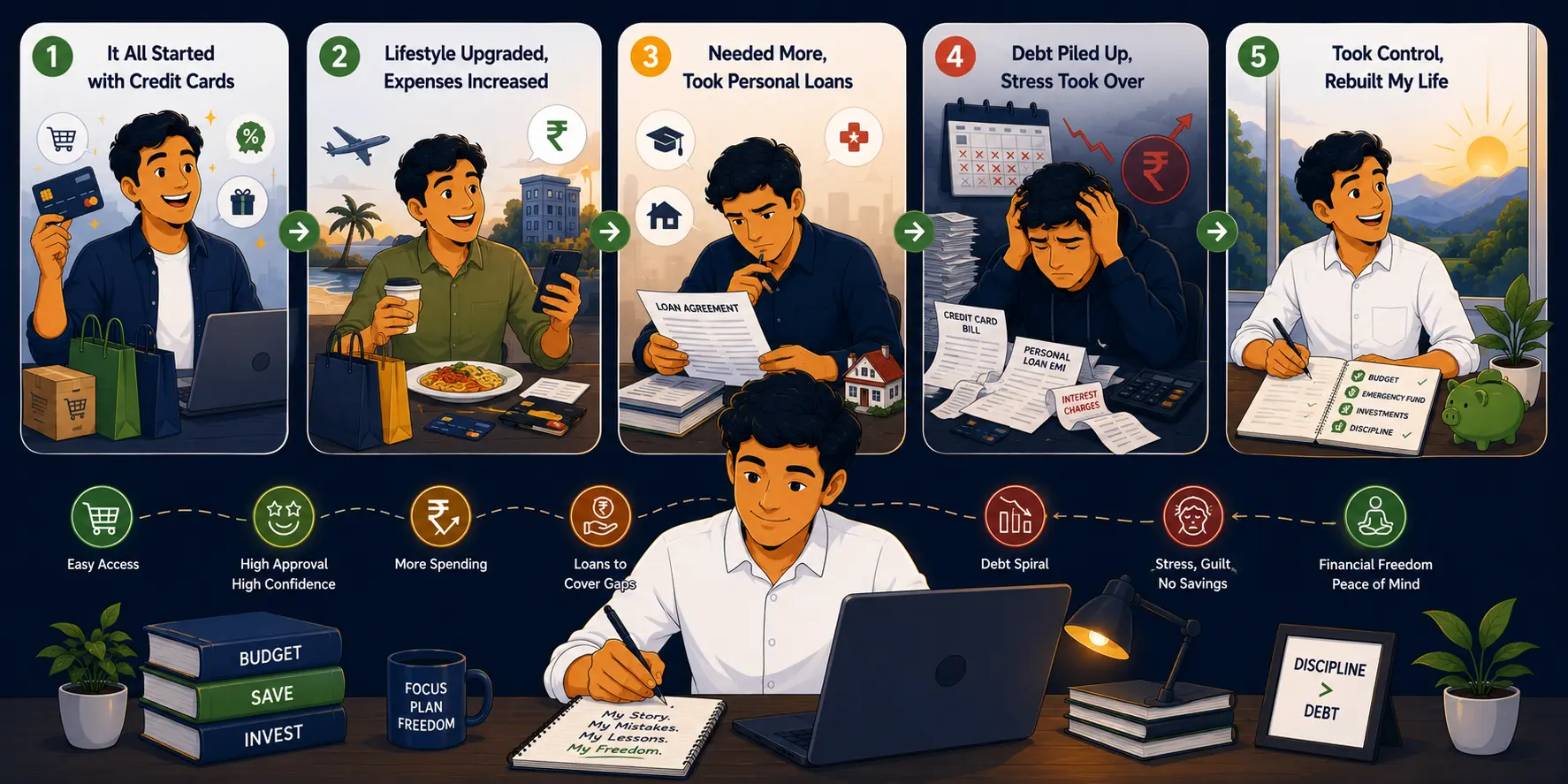
Looking back, the progression was almost mechanical. Each step felt like a solution to the step before it. None of them felt like a mistake while I was making it.
One credit card to five credit cards. One consumer loan to multiple consumer loans. One personal loan to close the consumer loans. Multiple personal loans. One large personal loan to close the smaller personal loans.
Each stage felt like simplification. Each stage made the underlying problem worse.
It took me 4 to 5 years to fully understand what had happened. The damage was not from one bad decision. It was from a long chain of individually reasonable-sounding decisions, each one made under mild financial pressure, each one choosing short-term comfort over long-term stability.
In this whole process I never calculated the cost of closing one loan and opening another: processing fees, foreclosure charges, the tiny interest rate saving I thought I was getting wiped out entirely by the fees to exit. I was running in place and calling it progress. If I had used a payoff calculator early on, I would have seen exactly how long the minimum due path was going to take and how much it was going to cost.
If I had simply reduced my expenses during the tight months instead of borrowing more, the trajectory would have been completely different.
When money feels tight, the instinct is to find more money. The harder and more effective move is to reduce what you are spending. Borrowing to manage a cash flow problem does not solve the problem. It delays it, grows it, and makes the eventual reckoning more painful.
What I know now
I am not saying do not use credit cards. I still use them. But the relationship is completely different now.
I use a card when I already have the money and there is a genuine benefit to using the card instead of cash. I pay the full balance every month without exception. I do not carry outstanding balances, I do not take loans to close other loans, and I do not convince myself that a no-cost EMI is a free purchase.
The people who genuinely benefit from credit cards are the ones who never needed the credit in the first place. They use the card as a payment instrument, collect the rewards, and pay it off before the due date. The card works for them because they are in control of it, not relying on it.
That is the version of credit card usage worth aiming for. Not the version where you are juggling five cards, three EMIs, and a personal loan while telling yourself you have it under control.
Credit works well for those who do not need it. For them it gives cashback, reward points, savings. They are the ones who rarely rely on their cards despite holding lakhs of combined credit limit. They are in control. The card is just a tool.
I learned this the hard way over 4 to 5 years. You do not have to.
If you are currently carrying a credit card balance and want to see exactly how long it will take to clear it and how much interest you are paying, use the Credit Card Payoff Calculator. The numbers are often more alarming than people expect, and seeing them clearly is usually what pushes someone to take action.
Frequently Asked Questions
Stop adding new debt first. Then list all your cards and balances and focus extra payments on the highest interest card while paying minimums on the rest. Once that card is cleared, move to the next. Avoid taking personal loans to close card debt unless the interest rate is significantly lower and you are certain you will not accumulate new card debt. The payoff calculator on this site can help you map out a clear timeline.
No. In most no-cost EMI offers, the interest is either built into the product price or paid by the brand as a promotion cost. You also lose the instant discount you might have received for a full cash payment. More importantly, the EMI blocks your credit limit and commits your future income. The real cost is not always visible upfront.
The number is not the problem - the behaviour is. Someone with five cards who pays every one in full every month is in a better position than someone with one card who rolls over a balance. That said, more cards mean more statements to track, more due dates to remember, and more temptation to spend. Most people manage better with one or two cards.
Sometimes yes, but only if the personal loan interest rate is meaningfully lower than your card rate, and only if you commit to not using the card again until the loan is repaid. Personal loans typically charge 12 to 20 percent compared to 36 to 42 percent on cards. The saving is real - but only if you do not accumulate new card debt simultaneously, which is the trap most people fall into.