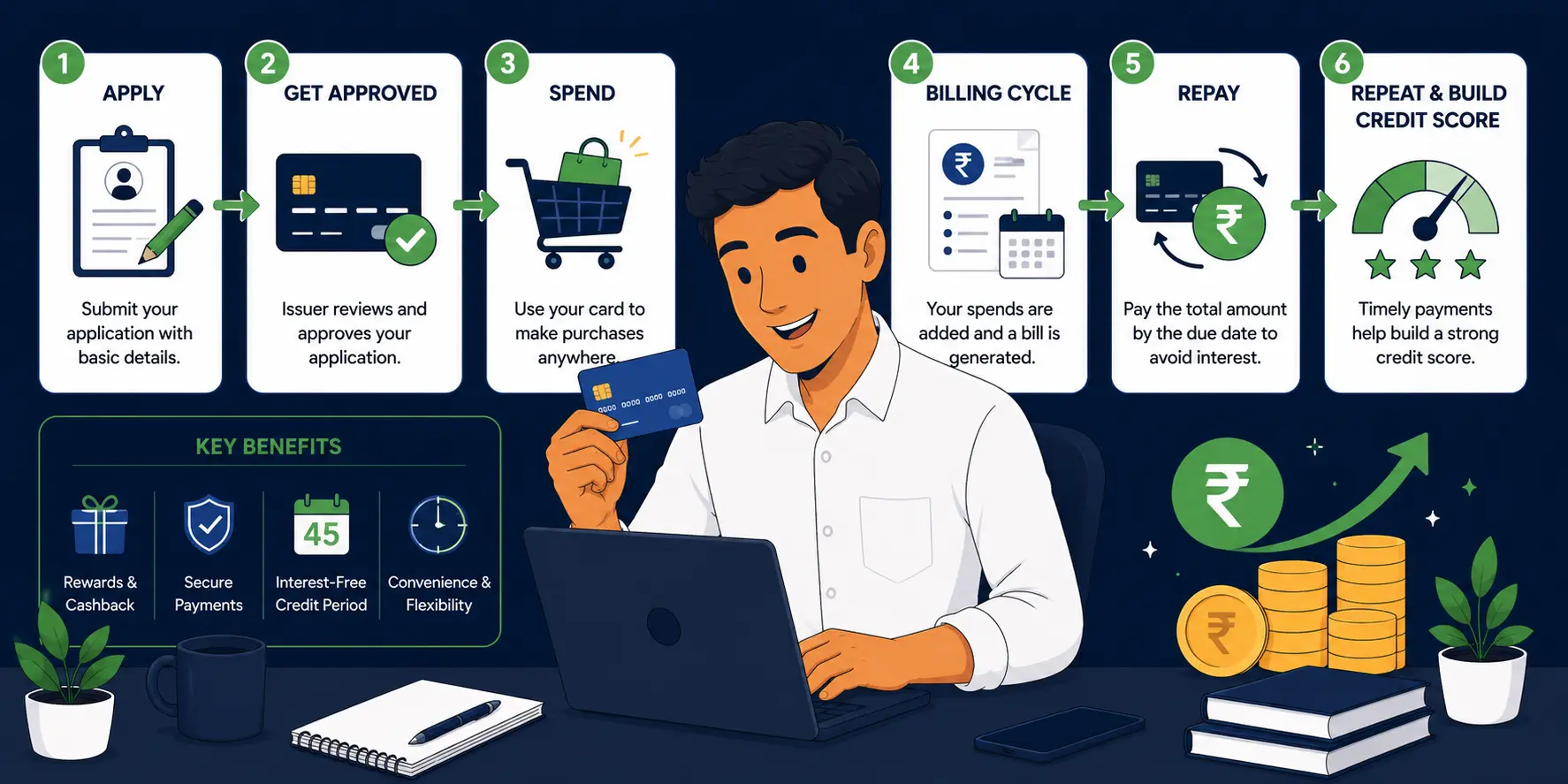
If you have ever received a credit card and thought, "I understand how to use it, but what actually happens behind the scenes?", you are not alone. A credit card looks simple when you tap or swipe it. The confusing part starts when the statement arrives.
What is the credit card balance? What is the billing cycle? Why are there two payment amounts? What happens when you pay only the minimum due? And what does revolving balance actually mean?
This article breaks the whole process down in plain language, with examples relevant to how credit cards are used in India.
What Is a Credit Card?
A credit card is a revolving line of credit. The bank or card issuer gives you a credit limit, and you can use part of that limit to make purchases without paying from your bank account at that moment.
The important word is revolving. With a personal loan, you normally borrow a fixed amount and repay it through scheduled EMIs. With a credit card, your balance can go up when you spend and come down when you repay. As you repay, the available credit becomes available again.
For example, if your credit limit is ₹1,00,000 and you spend ₹20,000, roughly ₹80,000 of the limit remains available, subject to other pending transactions or adjustments. If you later repay ₹10,000, your available credit can increase again.
How Do Credit Cards Work? The Simple Cycle
The basic process is easier to understand when you see it as a repeating cycle.
The issuer approves a maximum amount you can use on the card.
Your transactions reduce the amount of available credit while they are outstanding.
The issuer collects eligible transactions during the billing period and generates a statement.
You see the statement balance, minimum amount due, payment due date and other applicable charges or credits.
Pay the total amount due on time to use the interest-free period for eligible purchases, or carry a balance according to the card terms.
As you spend and repay, the balance and available credit keep changing.
Credit Card Billing Cycle, Statement Date and Due Date
The billing cycle is the period during which your card transactions are collected for a statement. At the end of that cycle, the issuer generates your credit card statement.
The statement normally shows your transactions, total amount due, minimum amount due, payment due date, available credit and applicable charges or credits. Your exact dates depend on the card issuer and the billing cycle assigned to your card.
The payment due date is the date by which you need to make the required payment. RBI rules require card issuers to provide at least a fortnight between dispatch of the bill or statement and the payment due date before interest starts being charged. The exact interest-free period for a purchase can be longer or shorter depending on when that purchase was made in the billing cycle.
This is why the idea of "45 days free credit" should not be treated as a fixed promise for every purchase. A purchase made just after the statement date can have much more time before its due date than a purchase made just before the statement is generated.
What Is a Credit Card Limit?
Your credit limit is the maximum revolving credit the issuer allows on the card, subject to the issuer's terms and available credit. It is one of the first numbers you should understand because it determines how much of the card's borrowing facility is available to you.
For example, if your credit limit is ₹1,00,000 and you have ₹20,000 in outstanding transactions, roughly ₹80,000 remains available, subject to pending transactions and other adjustments. When you make a payment, available credit can increase again after the payment is processed.
Your credit utilization is the portion of your available credit that you are using. For example, ₹40,000 used against a ₹1,00,000 total limit is 40 percent utilization.
Lower utilization is generally viewed more favorably by credit scoring systems, but there is no single 30 percent rule that guarantees a good credit score. Payment history, length of credit history, credit mix, recent applications and other factors also matter.
What Is a Credit Card Balance?
Your credit card balance is the amount you owe on the card after accounting for purchases, payments, refunds, reversals and other posted transactions. You may see more than one balance figure in your banking app, so check what each figure represents.
If you do not clear the amount due and part of the balance moves into a later billing cycle, that amount becomes a revolving balance. In simple terms, you are carrying the unpaid credit card balance forward instead of clearing it in full.
This is where the term credit card payoff becomes useful. Paying off a credit card means clearing the balance you are carrying. So when someone says "pay off my credit card", they generally mean bringing the outstanding or revolving balance down to zero.
If you are already carrying a balance, our Credit Card Payoff Calculator can show the repayment month by month, including different payment amounts and changes during repayment.
Full Amount Due vs Minimum Due
This is one of the most important things to understand about how credit cards work.
RBI specifically requires card issuers to explain the consequences of paying only the minimum amount due and to warn customers that repayment can stretch over months or years with consequential interest. The interest-free period is also suspended when a previous month's balance remains outstanding.
Statement balance: ₹50,000
Minimum due: ₹2,500
Payment made: ₹2,500
Balance still outstanding: ₹47,500, before considering interest, fees, new spending or other adjustments.
The important point is that paying ₹2,500 does not turn the remaining ₹47,500 into an interest-free loan.
If you want to see the difference between making a small payment and paying more aggressively, the Credit Card Payoff Calculator is built for exactly that kind of month-by-month planning.
For a deeper look at why minimum payments can keep a balance around for a long time, see How the Credit Card Minimum Due Trap Works.
How Does Credit Card Interest Work in India?
Credit card interest is not the same as the interest on a normal EMI loan. Card issuers disclose annualized rates and the method used to calculate interest. The statement should also show how the unpaid amount is considered for interest calculation.
If you clear the total amount due within the applicable interest-free period, eligible purchases can remain interest-free. If you carry a balance, the interest-free period can be lost and interest may be charged from transaction dates on the outstanding amount, after accounting for payments, refunds and reversals, according to the issuer's terms and applicable RBI rules.
Suppose your statement shows ₹50,000 and you pay only ₹5,000.
The remaining balance does not simply sit there at zero cost. Once the interest-free period is lost, the issuer can calculate interest using its disclosed method and applicable rate.
The exact interest cannot be estimated correctly from the statement balance alone because transaction dates, payments, refunds, the issuer's calculation method, taxes and applicable fees can affect the result.
This is why looking only at the minimum due can give you a misleading picture of how quickly the balance will disappear.
Why a Revolving Credit Card Balance Becomes Expensive
The problem with a revolving balance is not simply that you owe money. It is that you can continue adding new purchases while interest is being charged on the balance you already carry.
Imagine you have ₹60,000 outstanding and keep adding ₹5,000 to ₹10,000 of new spending every month while making only small payments. Even if the account never looks alarming on a single statement, the balance can remain high for a long time.
This is why the goal should not be to find the smallest payment that keeps the account current. The better question is: How much can I consistently pay so that the revolving balance actually comes down?
How Credit Card Payments Work
You can usually make a credit card payment through the payment methods supported by your issuer. When you pay, the amount is credited to the card account and your outstanding balance and available credit are updated according to the issuer's processing time.
A payment made before the due date is not automatically the same thing as paying the full amount due. If you pay only part of the statement balance, you may still carry a revolving balance and lose the interest-free benefit according to the card's terms.
If your aim is to become debt-free, focus on the balance reduction, not just whether you have paid the minimum amount.
Credit Card EMI: What Happens When You Convert a Purchase?
Many cards allow eligible purchases or outstanding balances to be converted into an EMI plan. This can make a large payment easier to manage, but it is not free borrowing.
Before accepting a credit card EMI offer, check the interest rate, processing fee, GST or other applicable charges, foreclosure rules and the total amount you will repay. Do not compare an EMI rate with another loan rate without checking whether one is a flat rate and the other is a reducing rate.
Our earlier guide explains the difference between flat and reducing interest rates with a real numerical example.
How Credit Card Issuers Make Money
A credit card can make money for the issuer in several ways. The main sources can include interest on revolving balances, annual or other card fees, charges for certain services, and fees associated with processing card transactions.
This does not mean every credit card user is profitable in the same way. A customer who pays the full amount on time may avoid interest on eligible purchases while still generating revenue for the issuer through other parts of the card business.
What About Cash Withdrawals From a Credit Card?
Cash withdrawal is different from an ordinary purchase. Cash advances can have separate fees and interest terms, and the interest-free purchase period generally does not apply in the same way.
Always check the card's current fee schedule and APR before withdrawing cash. If you only need short-term cash, compare the total cost with other borrowing options rather than assuming your credit card is the cheapest option.
Credit Card Safety and Unauthorised Transactions
Credit cards can be convenient for online payments, but you still need to monitor transactions. Turn on transaction alerts, review your statements and report unauthorised transactions to the issuer promptly.
RBI has separate rules covering customer liability for unauthorised electronic transactions, including situations where timely reporting can result in zero or limited customer liability. Your card issuer's terms and the circumstances of the transaction also matter.
The Rules I Would Follow With a Credit Card
A credit card can be a very useful financial tool when the balance is controlled. The same card can become expensive debt when spending continues faster than repayment.
The card itself is not the problem. The important part is understanding what happens to the balance after you spend, what happens when you do not pay in full, and how quickly you can bring the balance back down.
How to Pay Off a Credit Card Balance
If you already have a revolving credit card balance, the next step is to turn it into a clear repayment plan. Start with the current balance, the applicable interest rate, the minimum due and the amount you can realistically pay each month.
Then test what happens if you increase the payment. A small increase can change the repayment period substantially when it is applied consistently.
Our Credit Card Payoff Calculator is designed around this real-life problem. You can see the balance month by month and test repayment scenarios rather than looking at one final number.
If you are trying to understand how revolving credit can turn into a longer debt cycle, also read How Credit Card Debt Becomes a Trap.
Frequently Asked Questions
Available credit can change as purchases, refunds, payments and pending transactions are processed. It does not always match your statement balance because the two figures can represent different points in the billing cycle.
Usually yes, once the payment has been processed and the corresponding credit becomes available again. If you are carrying a revolving balance, however, using the card again can make repayment take longer and increase the amount of interest you pay.
It means you have paid the required minimum shown for that statement, not that you have cleared the bill. Any remaining balance can continue into the next cycle and may attract interest according to the issuer's terms.
The statement balance is the amount recorded when your billing cycle closes. Your current balance can change afterward as you make new purchases, payments, refunds or other transactions.
No. A personal loan normally gives you a fixed amount that you repay through scheduled installments. A credit card is revolving credit, so the amount you owe can change as you spend and repay.
Revolving credit means the borrowing facility can be used, repaid and used again within the approved limit. If you carry an unpaid balance from one cycle to another, that balance is commonly called a revolving balance.
Stop adding unnecessary spending to the balance and choose a payment amount that you can maintain consistently. Paying more than the minimum generally shortens the repayment period. Our Credit Card Payoff Calculator can help you compare different payment scenarios.