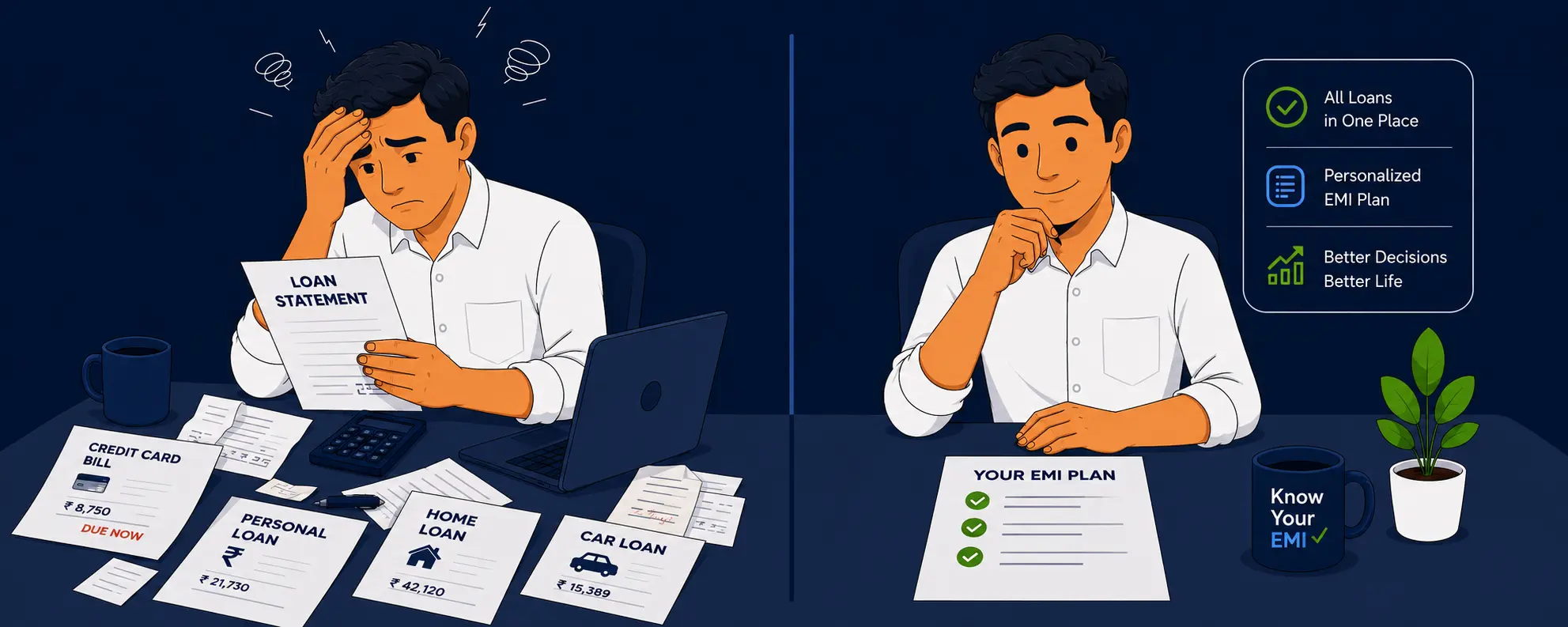
Running three EMIs at the same time is not just financially tiring. It is mentally tiring. One for the personal loan. One for the credit card EMI. One for the car. Different due dates, different banks, different interest rates, and a constant sense that you are paying a lot of money every month but the balances are not moving fast enough.
That is where debt consolidation enters the picture. The idea sounds simple: bring several debts under one repayment plan so you have fewer payments to manage. But the interesting question is not whether you can turn several EMIs into one. It is whether doing that actually improves your situation.
Sometimes it can lower the cost of expensive debt. Sometimes it simply makes the monthly number look smaller by stretching the repayment for longer. And sometimes the problem was never the number of loans in the first place. This guide looks at the different ways to consolidate debt, what the numbers really mean, and the things worth checking before you make the switch.
On this page
What Is Debt Consolidation?
Debt consolidation means bringing multiple debts together under one repayment plan. This can involve using a new loan or credit facility to clear existing balances, after which you make one repayment instead of keeping track of several separate obligations.
The attraction is not just the phrase "one EMI." It can also be about replacing a costly form of borrowing with a cheaper one, simplifying several due dates, or giving a stretched monthly budget some breathing room. Those are three different reasons to consolidate, and they should not be confused with one another.
In India, people may consider a personal loan, a balance transfer, an eligible home loan top-up, or a loan against property depending on the type and size of the debt. The suitable route depends on the existing loans, the rate you can qualify for, the fees involved, and whether you are comfortable with any security attached to the new borrowing.
↑ Back to topHow Does Debt Consolidation Work?
The useful way to think about consolidation is as a before-and-after comparison. Before you do anything, write down every debt you are considering: the outstanding balance, current interest rate, monthly payment, remaining tenure, and any cost for closing it early.
Then look at the proposed consolidation option as a complete package. What is the new interest rate? What is the new EMI? How long will you be paying it? What fees are added at the beginning? Once those numbers are clear, compare the total cost of staying where you are with the total cost of moving to the new repayment plan.
If you go ahead, the new facility is used according to its terms to settle the debts being consolidated. Keep the closure or settlement documents from the old lenders and check your credit report after the accounts are updated. The paperwork matters because the job is not finished just because the old balances show zero.
↑ Back to top4 Ways to Consolidate Debt
There is no single debt consolidation loan that works for everyone. The method depends on what kind of debt you have and what borrowing options are available to you.
1. Personal loan
A personal loan is one route for combining unsecured debts such as eligible credit card outstanding and smaller loans. The main attraction is straightforward comparison: if the new loan costs substantially less than the debt it replaces, the interest saving may justify the switch. Processing fees and the new tenure still need to be included in the calculation.
2. Balance transfer
A balance transfer is more focused. Instead of combining several different debts, you move an existing loan to another lender or facility under new terms. This can be worth examining when you have one large loan and the main problem is the interest rate rather than the number of EMIs. You can compare the numbers using our Balance Transfer Calculator.
3. Home loan top-up
If you already have a home loan and qualify for a top-up, the additional borrowing may carry a lower rate than some unsecured debts. But a lower rate does not erase the underlying trade-off. You are using borrowing connected to a property to deal with another financial obligation, so the terms, eligibility and consequences of default need to be understood clearly.
4. Loan against property
A loan against property can be considered when the debt amount is substantial and the borrower has suitable property to offer as security. It can provide access to larger borrowing than an unsecured option in some cases, but that does not make it a simple replacement for a personal loan. The property itself becomes part of the risk equation.
Can You Consolidate Credit Card Debt?
Yes, credit card debt can be part of a consolidation plan when the chosen borrowing facility can be used for that purpose. This is one of the situations where the difference between the old debt and the new debt can matter a lot, because a revolving credit card balance can remain expensive when it is carried from month to month.
But clearing a card balance is only the financial part of the story. Imagine someone who finally gets all of their cards back to zero. For the first time in months, the statements look clean. Then an unexpected expense arrives, the card is used again, and a new revolving balance starts building while the consolidation loan EMI is still running in the background. The old problem has quietly returned in a different form.
That is why credit card debt consolidation should be treated as both a repayment decision and a spending reset. For a deeper explanation of credit card balances, minimum due and revolving credit, see How Credit Cards Work. If you want to estimate how long a balance could take to clear under different payments, use the Credit Card Payoff Calculator.
↑ Back to topDebt Consolidation and Monthly EMI
One of the first things people notice after consolidation is the EMI. That number can feel like the answer because several payments have become one. But an EMI is only one part of the picture.
A longer tenure can bring the monthly payment down while increasing the amount of time interest is charged. So if your goal is to save money, compare the total remaining repayment on the existing debts with the full repayment of the consolidated loan. If your goal is immediate cash flow relief, a lower EMI may still be useful even when the total cost is higher. The important thing is to know which problem you are actually trying to solve.
If you want to understand how the EMI itself is calculated and how the interest component changes over the repayment period, read How EMI Is Calculated.
Existing debts: several payments with a combined remaining repayment of Rs. 5,40,000
Consolidated option: one loan with a lower monthly EMI but a total repayment of Rs. 5,70,000
The new EMI is smaller, but the total cost is higher. The two numbers are answering different questions.
Consolidation Charges and Other Costs
The interest rate is usually the number that gets the attention, but switching debt can have several other costs. Before comparing two options, make a simple list of everything that can affect the final cost.
Costs worth checking
The same logic applies to consolidation charges. A saving that looks attractive before fees may become very small after all the switching costs are included. Do the comparison using the numbers you would actually pay, not the headline offer.
↑ Back to topWhen Does Debt Consolidation Make Sense?
There is no magic interest-rate gap or income percentage that automatically makes consolidation the right choice. The answer depends on the debts you have today and the exact terms you can get tomorrow. Still, some situations are worth examining closely.
Your existing debts carry high interest rates
This is the clearest reason to run the numbers. If a large part of your debt is expensive credit card outstanding or another high-cost loan, replacing it with a meaningfully lower rate can change the amount of interest going out every month. The bigger the rate difference and the more balance you have left, the more important the comparison becomes.
You have too many EMIs to track
Sometimes the problem is operational rather than mathematical. Four lenders can mean four due dates, four statements and four opportunities to miss something. One repayment can be easier to manage. That simplicity has value, especially if your current repayment schedule is difficult to keep track of.
Your monthly cash flow is stretched thin
If the combined EMIs leave very little room for rent, household expenses, emergencies or savings, reducing the monthly obligation may give you breathing room. But this is where the difference between monthly affordability and total cost matters most. A longer tenure can solve today's cash-flow problem while creating a larger interest bill later.
You can get a meaningfully lower rate
The word "meaningfully" matters. A small rate reduction on a loan that is almost finished may not justify the fees and paperwork. A much larger rate difference on a substantial outstanding balance can be a different story. The only reliable way to know is to compare the full numbers.
You have a clear reason for consolidating, the new terms solve that problem, and the total cost still works after fees and the new tenure are included.
When Debt Consolidation May Not Help
Consolidation can be useful, but it is not a financial reset button. There are situations where keeping the existing debt or using a different strategy deserves a closer look.
When one loan is the real problem
If you have one large loan and the issue is simply its interest rate, a balance transfer may be more relevant than taking a new consolidation loan. You may not need to restructure everything just because one loan is expensive.
When the rate difference is too small
Moving from one rate to a slightly lower rate sounds good until the processing fee, closure charges and remaining tenure are included. If there is little interest left to save, the switch may accomplish very little.
When the new tenure is much longer
A debt with 18 months left can look very different after it is rolled into a new 48-month repayment. The monthly number may become easier, but the commitment lasts much longer. That is not necessarily wrong, especially when cash flow is under pressure, but it should be a conscious trade-off rather than an accidental one.
When the cleared credit cards become available spending again
This is the scenario worth taking seriously. If consolidation clears the cards but the spending pattern remains unchanged, you can end up carrying the new loan and a fresh card balance at the same time. In that situation, the consolidation has not solved the underlying debt cycle.
Debt Consolidation Tips
Before applying for a debt consolidation loan, write down the debts you want to replace and the exact numbers for each one. Do not rely on memory or rough monthly figures. The outstanding balance, interest rate, remaining tenure and closure cost can completely change the comparison.
Then get the actual offer, not just the advertised starting rate. Put the new rate, new tenure, processing charges and other costs beside the existing debt. If the new plan still looks better after that comparison, you have a much stronger basis for proceeding.
And if you have only one expensive loan, compare a balance transfer or a part payment before restructuring everything. Sometimes the answer to a complicated debt problem is surprisingly simple.
↑ Back to topFrequently Asked Questions
Applying for a new loan can involve a credit enquiry, and the effect on your credit profile depends on the lender and your circumstances. Closing or paying off existing accounts can also change what appears on your credit report. The important thing is to keep every repayment on the new loan on time.
Potentially, yes. The debts do not necessarily need to be with the same lender. What matters is whether the new loan or credit facility can be used to clear those particular balances and whether the resulting rate, tenure and fees make sense for you.
It depends on the lender's eligibility rules and whether the debts and new borrowing can legally be combined. A joint loan may be possible in some cases, but the lender will assess the applicants, income, credit history and repayment capacity.
No. A personal loan is one option, but consolidation can also involve a balance transfer, an eligible home loan top-up or other secured borrowing. The right comparison is between the actual terms available to you, not the name of the product.
Be careful. If only a short period remains on your existing loans, there may not be enough future interest to save to justify processing fees, prepayment charges or a new longer tenure. Compare the remaining cost of the old loans with the complete cost of the new one before switching.
Compare the final interest rate, monthly EMI, remaining tenure, total repayment, processing fee, applicable taxes and any charges for closing existing debts. Also check whether the new repayment fits your monthly budget without creating pressure elsewhere.